ADHD Brain OS › Free guides
ADHD task paralysis: 6 kinds of stuck (and a first step for each).
You know exactly what to do. You've known for hours. And you're still not doing it. Lots of people with ADHD (or brains that work like it) call this task paralysis. The usual advice, "just start", doesn't help, because "stuck" isn't one thing. There are at least six different kinds, and each one needs a different first step.
Here's the quick version we use in the ADHD Brain OS planner. Read the list, pick the one that sounds most like right now, and do only the first step.
The 6 kinds of stuck
The task is a whole project in disguise
"Do taxes" or "clean the flat" isn't a task, it's twenty. Your brain can't find the door.
First step: write only the very first physical action. Not the plan. Just "open the folder" or "put the dishes in the sink".
Nothing about it is interesting
You can do it; you just can't make yourself care for long enough to begin.
First step: race a 3-song playlist. Work only until the music stops, then you're allowed to quit. Often you won't.
It might go badly, so it never starts
The reply to your boss, the call to the bank, the message you owe a friend.
First step: write an ugly draft on purpose, as badly as you like, then fix only the worst line and send it fast.
You can't do step 2 without step 1
A password, a document, an answer from someone else. The block is real, not a character flaw.
First step: get the missing bit first. Make "find the login" or "ask Sam for the file" the whole task for now.
There's nothing left in the tank
Hungry, thirsty, tired, overstimulated. No method works on zero fuel.
First step: eat something, drink water, then do a tiny version of the task (five minutes, or one item). A low-battery day is still a day.
Everything feels equally urgent
Twelve things are on fire, so you do none of them and scroll instead.
First step: earliest deadline wins. If nothing has a deadline, pick the one that's quickest to finish.
Why naming the kind of stuck helps
"Just do it" treats every stuck moment the same. But a scary email and a boring spreadsheet are different problems: one needs less pressure, the other needs more stimulation. Picking the right category turns a vague feeling ("I'm useless today") into a specific, solvable problem ("this is a too-big task, so I need a smaller first step").
It also takes the shame out of it. You're not lazy, you're stuck in a particular way, and there's a particular first step for it.
Make the first step tiny: the 2-minute rule
Whatever kind of stuck it is, the first step should take under two minutes and be something you could do right now, from where you're sitting. A few examples:
- "Write the report" → open a blank document and type the title
- "Sort out my finances" → log into the bank app, that's all
- "Go to the gym" → put your shoes by the door
- "Reply to everyone" → reply to the oldest message with one sentence
Once the first step is done, you're allowed to stop. Starting is the hard part; momentum often does the rest.
Put it on paper
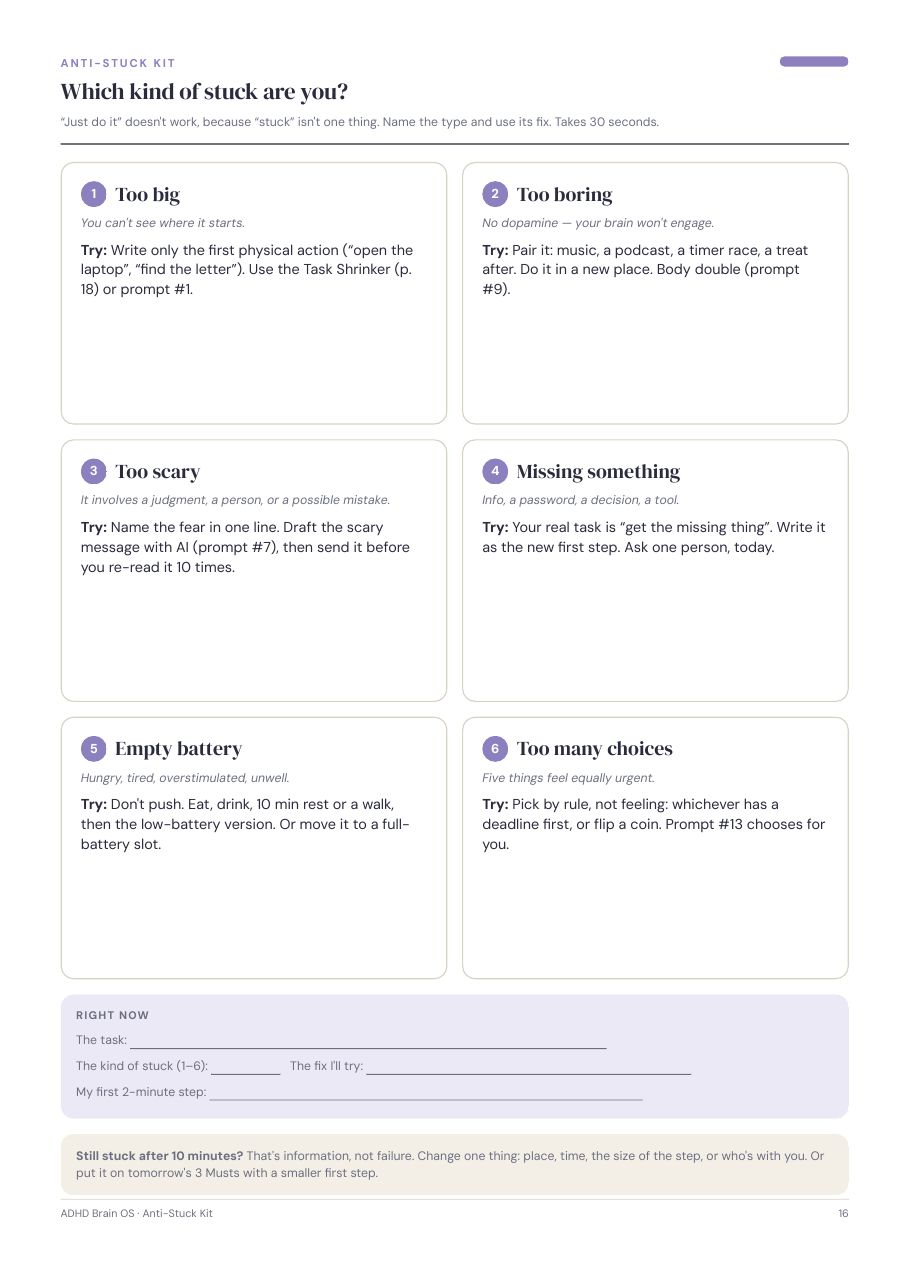
Working it out in your head while you're stuck is hard. Writing it down helps: circle the kind of stuck, write one first step, set a short timer. The ADHD Brain OS printable planner has a whole Anti-Stuck Kit built on this idea: the 6 kinds of stuck, 20 two-minute starters, a task shrinker, focus sprints and a dopamine menu for low-motivation days.
If you'd like to try the approach first, the free Starter Kit includes the Brain Profile quiz and the Today's 3 Musts daily page, which uses the same "tiny first step" rule for every task.
Quick recap
- Notice you're stuck (no judgement).
- Name which of the 6 kinds it is: too big, too boring, too scary, missing something, empty battery, too many choices.
- Do only the matching first step, and keep it under 2 minutes.
- Allowed to stop after. Allowed to keep going.